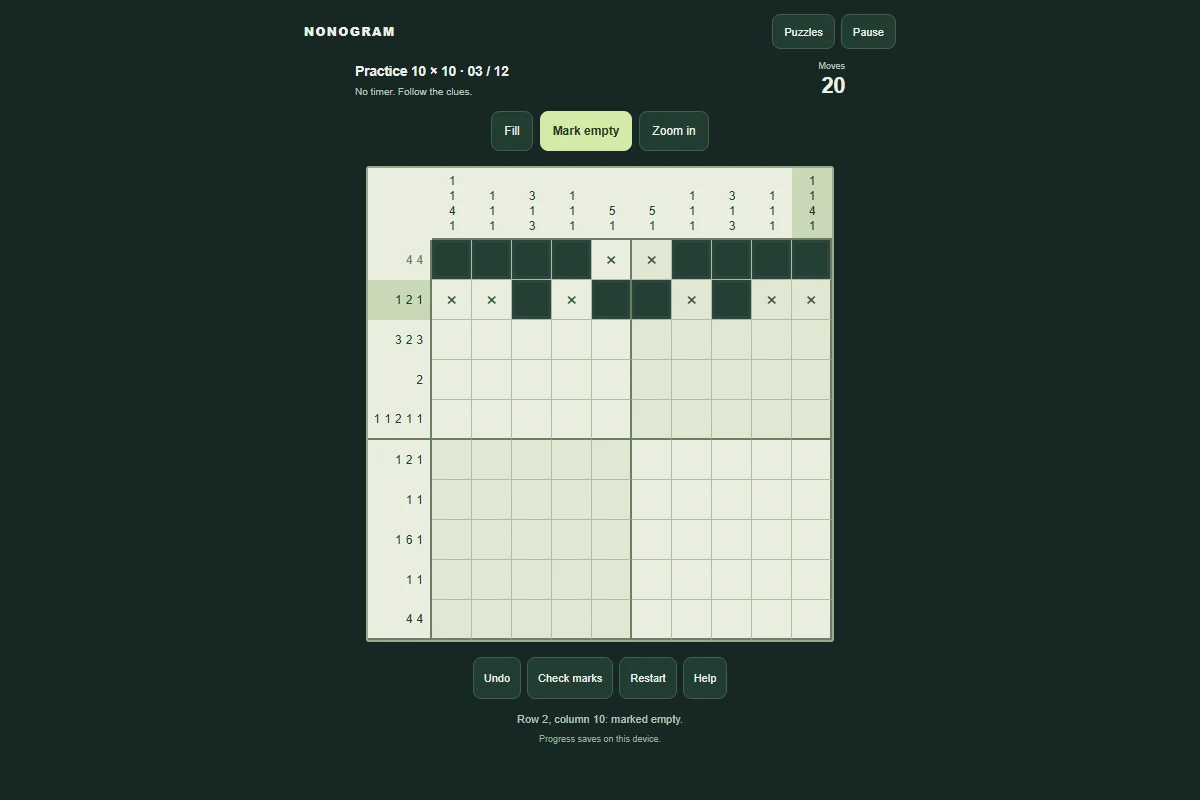
How to play Nonogram, one clue at a time.
Turn a grid of numbers into a picture. Follow this complete 5 × 5 example, then play the same puzzle.
Try the tutorial puzzle| 1 | 1 | 5 | 1 | 1 | |
|---|---|---|---|---|---|
| 1 | ? | ? | ? | ? | ? |
| 1 | ? | ? | ? | ? | ? |
| 5 | ? | ? | ? | ? | ? |
| 1 | ? | ? | ? | ? | ? |
| 1 | ? | ? | ? | ? | ? |
Read the numbers as groups of filled squares
A nonogram is a picture logic puzzle. The numbers beside each row and above each column tell you which groups of squares to fill. Your job is to find one pattern that satisfies both sets of clues.
A clue of 3 means one unbroken group of three filled squares. A clue of 2, 1 means a group of two, then at least one empty square, then a group of one. Read row clues from left to right and column clues from top to bottom.
The clues do not tell you exactly where a group starts. Extra empty squares may appear before, after or between groups. A 0 means the whole line is empty.
Two filled + one gap + two filled = five squares. There is only one way to fit these clues.
Solve your first 5 × 5 nonogram
This is the first 5 × 5 practice puzzle in our free online Nonogram game. Rows and columns are numbered from the top left. The question marks in these diagrams mean that we have not decided a square yet.
1. Fill the row with the clue 5
Row 3 asks for five consecutive filled squares. The row is only five squares wide, so fill every square in row 3. No guessing is needed.
| 1 | 1 | 5 | 1 | 1 | |
|---|---|---|---|---|---|
| 1 | ? | ? | ? | ? | ? |
| 1 | ? | ? | ? | ? | ? |
| 5 | Filled | Filled | Filled | Filled | Filled |
| 1 | ? | ? | ? | ? | ? |
| 1 | ? | ? | ? | ? | ? |
2. Fill the column with the clue 5
Column 3 also asks for five consecutive filled squares. Fill that column from top to bottom. Its middle square is already filled from step 1; leave it filled. You now have nine filled squares forming a cross.
| 1 | 1 | 5 | 1 | 1 | |
|---|---|---|---|---|---|
| 1 | ? | ? | Filled | ? | ? |
| 1 | ? | ? | Filled | ? | ? |
| 5 | Filled | Filled | Filled | Filled | Filled |
| 1 | ? | ? | Filled | ? | ? |
| 1 | ? | ? | Filled | ? | ? |
3. Rule out the remaining squares
Every other row has the clue 1, and its middle square is already filled. That one square completes its only group. Mark all remaining squares in those rows empty. The same check works for columns 1, 2, 4 and 5.
| 1 | 1 | 5 | 1 | 1 | |
|---|---|---|---|---|---|
| 1 | × | × | Filled | × | × |
| 1 | × | × | Filled | × | × |
| 5 | Filled | Filled | Filled | Filled | Filled |
| 1 | × | × | Filled | × | × |
| 1 | × | × | Filled | × | × |
Our game declares this puzzle complete as soon as the nine correct squares are filled. Crossing out every empty square is optional, but it helps you keep track of your reasoning on larger grids.
Use overlap when a clue does not fill the line
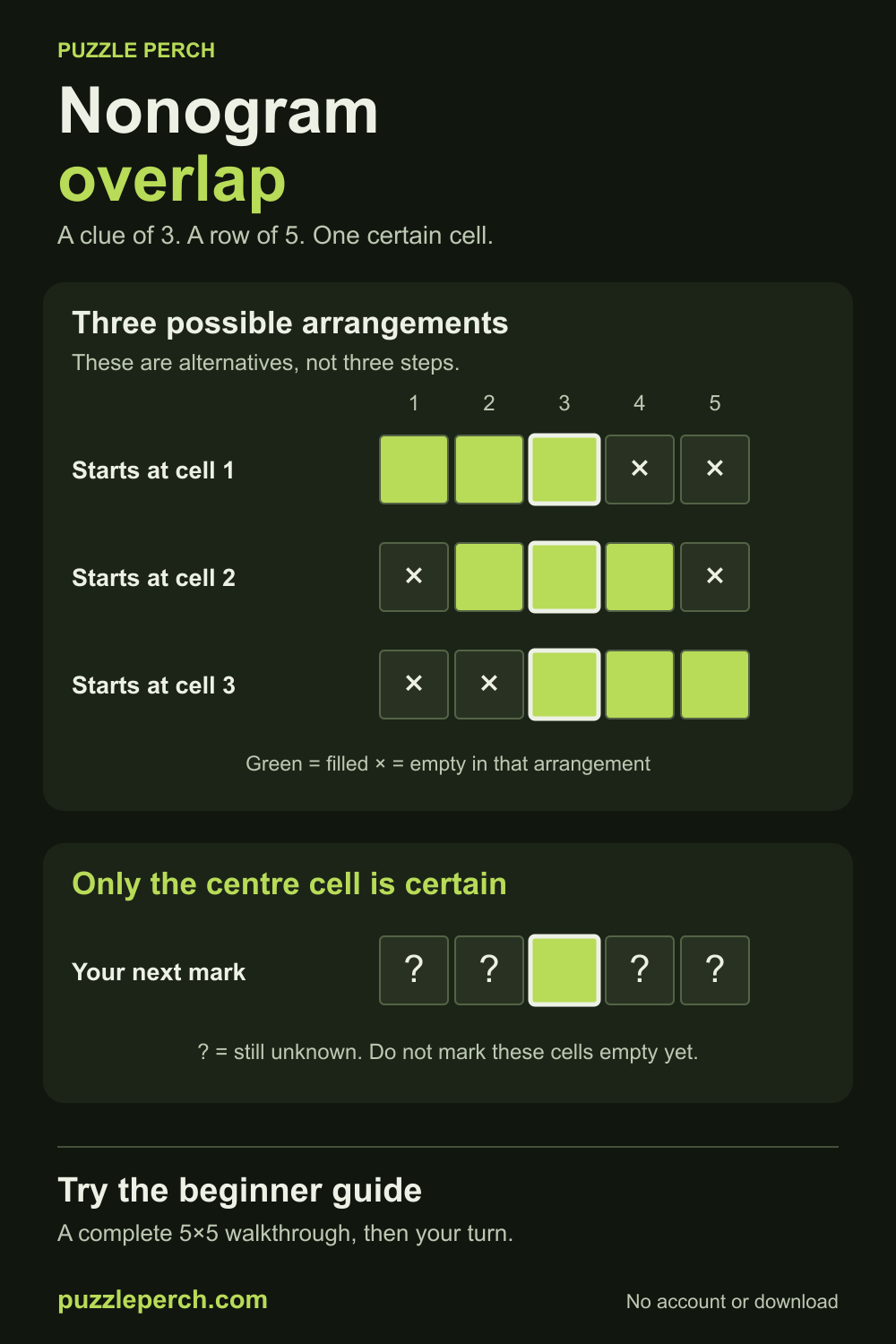
Suppose a five-square row has the clue 3. The group could start at square 1, 2 or 3. Compare all three possible placements:
Only the middle square is filled in every placement. You can safely fill that square on your real board. The other four are still undecided. These diagrams show alternatives, not three moves to copy and not proof that the outer squares are empty.
After each deduction, check the crossing column. New information from that column may fix where the row's group starts. Keep moving between rows and columns as the picture takes shape.
Try a row of your own in our Nonogram overlap guide and interactive line helper. It shows how known marks change the possible placements.
Keep an overlap reference card
Three mistakes to catch early
- Joining separate groups
- Clues 2, 1 require an empty square between the groups. Three connected filled squares would describe the clue 3 instead.
- Treating undecided squares as empty
- A square you have not proved filled might still belong to a group. Use an empty mark only when the clues rule it out.
- Filling what looks like a picture
- A familiar shape is a tempting shortcut. Check it against the row and column clues before making a mark.
In Puzzle Perch, Undo takes back a change and Check marks highlights incorrect marks without a penalty. Use them to investigate a mistake, then trace which clue led you there.