A puzzle break, on paper
24 printable Nonograms.
A pencil is all you need.
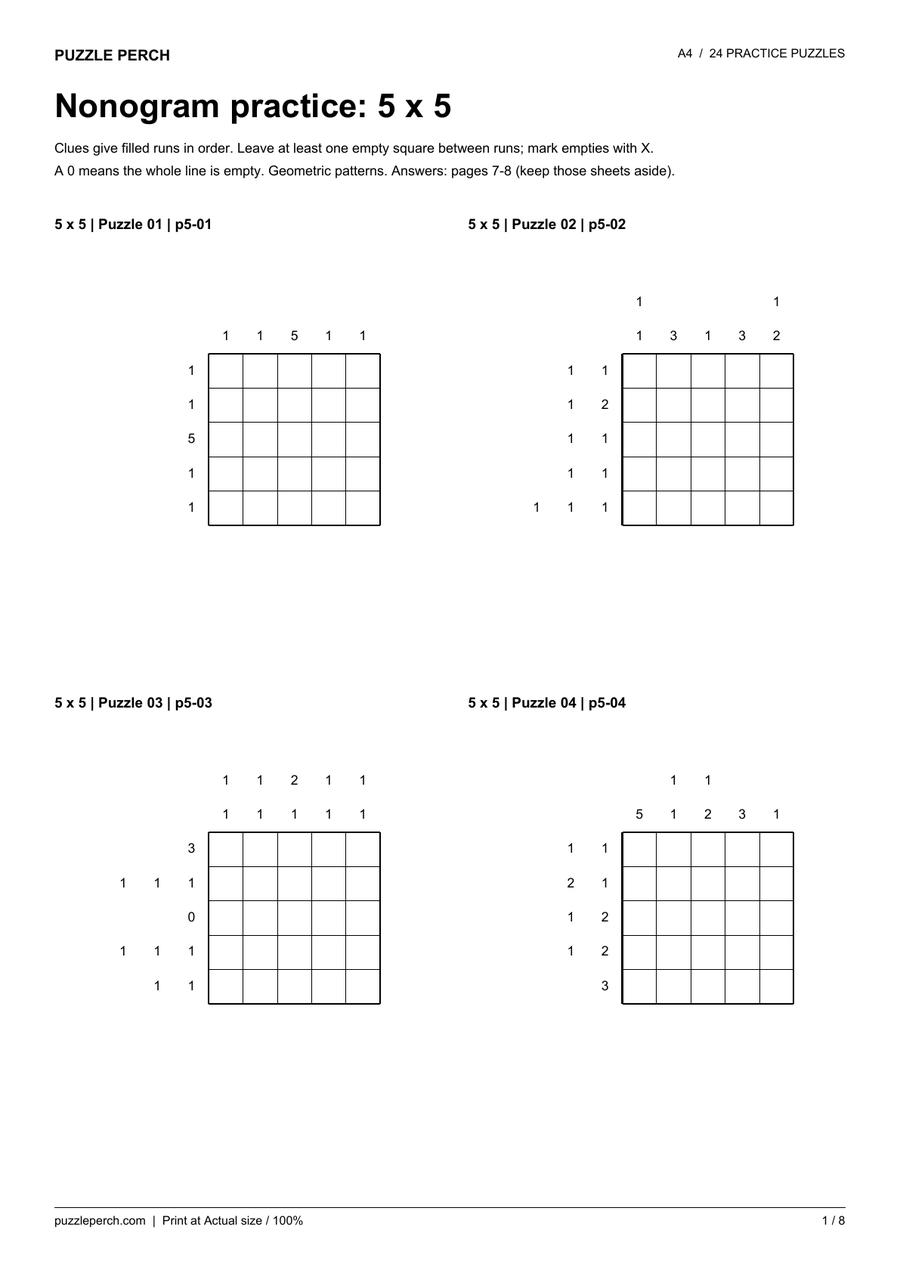
Twelve small 5 × 5 puzzles and twelve larger 10 × 10 puzzles, with the answers kept at the back. These geometric patterns come from the same checked practice bank you can play on Puzzle Perch.
Choose the PDF that matches your paper. Both contain the same puzzles, four to a sheet. No account needed.
- Download A4 PDF8 pages · 24 puzzles · 28.2 KB
- Download US Letter PDF8 pages · 24 puzzles · 27.2 KB
Blank puzzles on pages 1–6. Answers on pages 7–8.
Before you print
Keep the grids comfortable to write in.
- Open the A4 or US Letter edition for your printer's paper size.
- Choose Actual size or 100% in the print dialog. The sheets have margins and use black-and-white grids.
- Print pages 1–6 for puzzles only. Keep pages 7–8 separate until you want to check an answer.
Pages 1–3 contain the twelve 5 × 5 puzzles; pages 4–6 contain the twelve 10 × 10 puzzles. Puzzle numbers match the online practice picker within each size.
Read a line
Groups, gaps, then crossing clues.
A clue of 3, 1 means three filled squares, at least one empty square, then one filled square. Read rows from left to right and columns from top to bottom. A 0 means the line is empty.
Fill only what the clues prove. Use a small × for a square you know is empty, and leave undecided squares blank. Then check the crossing row or column.
New to the notation? Learn with a complete 5 × 5 example, or see how overlap proves a square.
Paper to practice
Try the same puzzle in your browser.
Open a practice size, choose Puzzles, select the size, then pick the number printed on your sheet. For example, Practice 5 × 5 · 03 is puzzle 3 in the 5 × 5 picker.
If you get stuck, Explain one move points to a useful line. Show why compares its possible placements. You make the mark yourself; use Check marks if an earlier choice may be wrong.